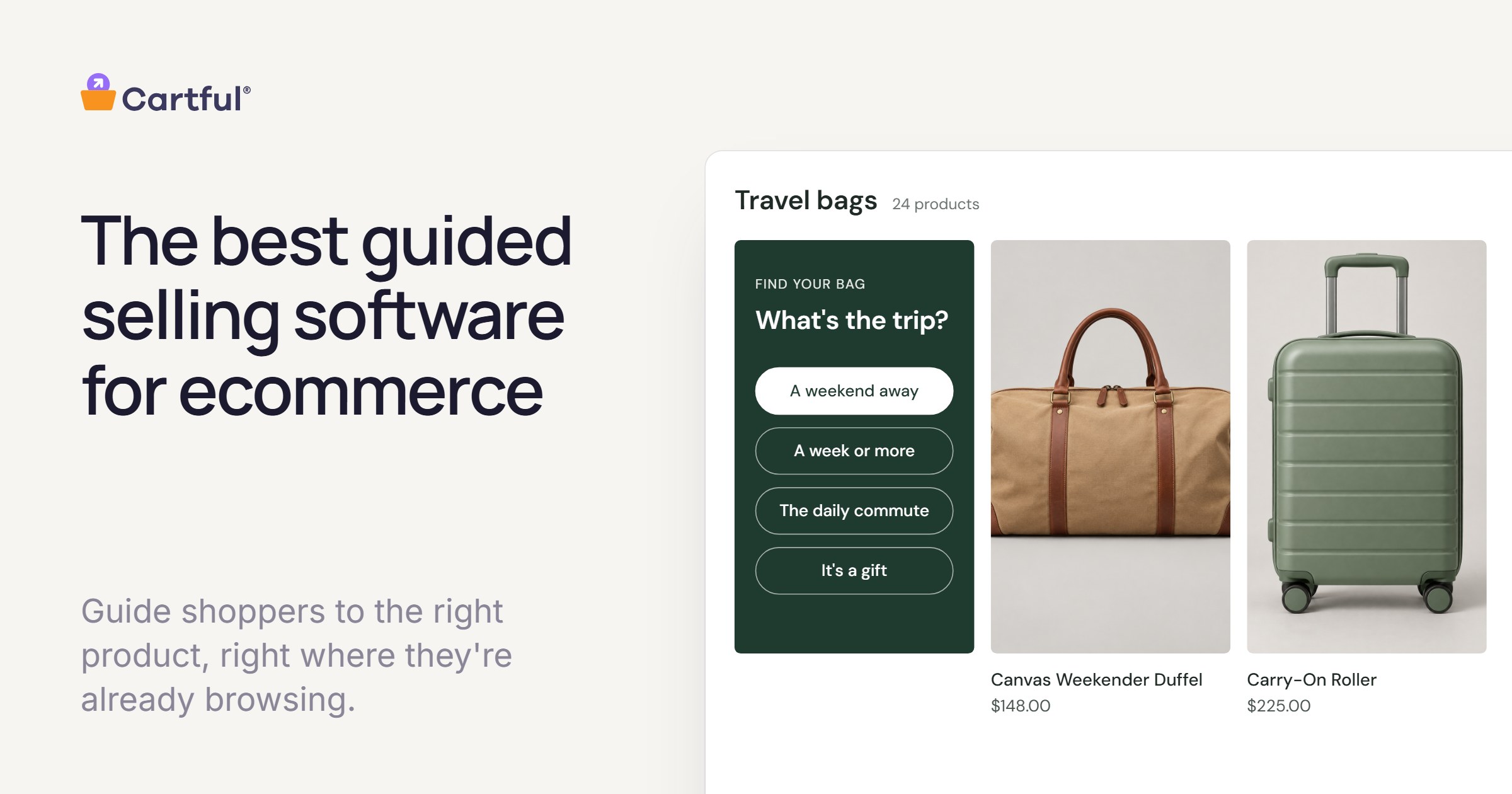
In a store, a good associate asks a couple of questions and points you to the right product. Online, shoppers get a grid of forty options and a filter panel, and many leave without choosing. Guided selling software closes that gap. It asks shoppers what they need, through a product quiz, a product finder or a conversation, and recommends the product that suits them, with a reason.
We compared seven guided selling tools for ecommerce brands: what each one does, who it’s best for, and where it falls short.
In short
- Best overall: Cartful. Quizzes and micro-quizzes that match your site from the first version, deep control over every recommendation, and the same guidance on product pages and recommendation rows.
- Best for large, technical catalogs: Zoovu.
- Best for a Shopify quiz that feeds Klaviyo: Octane AI.
- Best for quizzes plus pop-ups and shopper identification: Digioh.
- Best for a self-serve quiz on a small budget: RevenueHunt.
- Best for product finders with behavioral nudges: Crobox.
- Best for European retailers that want scripted advice: Aiden.
What is guided selling?
Guided selling helps a shopper choose by asking what they need and recommending the right product, the way a store associate would. Online, it takes the form of product quizzes, product finders, guidance on product pages and AI shopping assistants.
Brands use it to lift conversion and order value, cut returns from wrong purchases, and learn what shoppers want in their own words. The tools differ most in where the guidance shows up and in who decides what gets recommended.
How we chose
We build guided selling for brands like HOKA, Shiseido, OSEA and Altra, so we know this category from the inside. For this list we looked at each tool’s own website and documentation, public reviews where we could find them, and the roundups buyers already read, as of November 2026. We compared them on five things:
- Where the guidance shows up: a quiz only, or product pages, recommendation rows and chat as well.
- Who controls the recommendation: your team’s rules, an AI, or both.
- What happens to the answers: email, SMS, customer profiles and analytics.
- Platforms supported.
- How much work it takes to launch and maintain.
We’ve left prices out because they change often. Check each vendor’s site for current plans.
Guided selling software compared
| Tool | Best for | What it covers | Platforms | How you start |
|---|---|---|---|---|
| Cartful | On-brand quizzes and micro-quizzes, with the same guidance on product pages and recommendation rows | Quizzes, micro-quizzes and finders, product page guidance, recommendation rows, product data for AI agents | Shopify (native app), plus any platform where you can add a script and share a product feed | Demo on your own catalog |
| Zoovu | Large, technical catalogs in B2C and B2B | Search, product finders, configurators, AI assistant | Shopify Plus, Salesforce Commerce Cloud, SAP, BigCommerce, WooCommerce and others | Demo, then a tailored proposal |
| Octane AI | Shopify brands growing email and SMS with a quiz | Quizzes, quiz analytics, shopper profiles | Shopify | Self-serve app |
| Digioh | Quizzes as part of pop-ups and shopper identification | Quizzes, pop-ups, identification, onsite personalization | Shopify, WooCommerce, Magento, BigCommerce, Salesforce Commerce Cloud and others | Talk to the team; hands-on onboarding |
| RevenueHunt | A capable quiz on a small budget | Quizzes | Shopify, WooCommerce, BigCommerce, Magento; others through a product feed | Self-serve app |
| Crobox | Product finders with nudges and testing | Product finders, AI assistant, dynamic messaging, data enrichment | Connects through a product feed and a site snippet | Demo |
| Aiden | European retailers that want scripted or AI-led product advice | Product finders, product page checks, advice agent | Magento, Shopify, BigCommerce and others | Demo |
The 7 best guided selling tools for ecommerce
1. Cartful
Best for: brands that want quizzes that look and sell like the rest of their site, and the same guidance on product pages and recommendation rows.
Most quiz tools make you build the product logic quiz by quiz, and the result often looks bolted on. Then your quiz, product pages and recommendation rows each tell shoppers something different. We built Cartful to fix that.
Cartful works out who each product is right for and why from your product data, pages and reviews, and your team has the final say. Every quiz is built from that one library, so the product logic is done before you add the first question.
Key features
- Quizzes that match your site. Studio pulls in your existing fonts, colors, buttons and spacing, so the first version already looks native. From there you can edit as deeply as you like in a drag-and-drop editor.
- Micro-quizzes. Short quizzes embedded directly in a product listing page, so you reach shoppers where they’re already browsing. They work well for finding the right product within a category, like OSEA’s scent quiz in its Bestsellers grid, or for gifting, like OneSkin’s holiday gift finder.
- Deep control over recommendations. Custom scoring, rules from your product data or decision trees, with exclusions, ranking and out-of-stock fallbacks. Every recommendation comes with a reason.
- The same guidance beyond the quiz. Affinity answers “is this right for me?” on the product page, Lineup fills recommendation rows, and Agentic Training writes your team’s answers into your own Shopify product listings. Chat is coming in Q1 2027.
- Email capture anywhere in the flow, with answers synced to Klaviyo, Attentive and your analytics.
- Runs anywhere. A native Shopify app, or any platform where you can add a script and share a product feed. SOC 2 Type II certified.
Who uses it: OSEA, Johnnie-O, Altra, Clé de Peau Beauté, Anastasia Beverly Hills and Steelcase, among others. OSEA’s skincare quiz brought a 36% lift in conversion among quiz users and 253% growth in email collection.
Not the right pick if: you want one simple quiz live this week on a small budget.
How you start: book a demo and we’ll show you guided selling on your own catalog.
2. Zoovu
Best for: large brands and manufacturers with big, technical catalogs.
Zoovu is a product discovery platform that covers site search, product finders and quizzes, configurators and an AI shopping assistant called Zoe, for B2C brands and B2B manufacturers. It names customers like Microsoft and Trek.
Key features: conversational and site search; guided selling assistants and product finders; product configurators; Zoe, its AI shopping assistant; product data enrichment.
Strengths: handles complex catalogs with compatibility rules and configurations; search, finders and configurators from one vendor; an MCP server that gives AI agents access to product data.
Limits: it’s built for enterprise teams and budgets, and sold through a demo and a tailored proposal. Some reviewers mention a learning curve.
3. Octane AI
Best for: Shopify brands that want a quiz to grow their email and SMS lists.
Octane AI is a quiz app for Shopify. Its AI builder, Phoenix, drafts a quiz from a description or an uploaded file, and its analytics show what each answer earns. Answers sync to Klaviyo, Attentive and Postscript.
Key features: the Phoenix AI builder; four ways to pick products (AI, manual rules, rankings or points); Smart Copy, which writes results for each shopper; a check for dead ends before you publish; shopper profiles.
Strengths: a fast AI builder; strong Klaviyo integration; revenue reporting by answer; a support team its reviewers praise often.
Limits: Shopify only. Octane describes itself as a quiz maker and analytics tool, so recommendations happen in the quiz and in follow-up emails. Some reviewers say the logic takes time to learn and want more design control.
4. Digioh
Best for: brands that want quizzes alongside pop-ups and shopper identification.
Digioh combines product quizzes, pop-ups and onsite personalization with Passport, its suite for identifying shoppers. Its AI agent builds campaigns from a description, and its team onboards you hands-on. It works across Shopify, WooCommerce, Magento, BigCommerce and Salesforce Commerce Cloud.
Key features: branching quizzes with weighted questions, bundles and add to cart; pop-ups and onsite experiences; Passport identification; Digioh AI, which builds campaigns from a prompt, a screenshot or a PDF; A/B testing.
Strengths: quizzes, pop-ups and identification in one tool; a long list of integrations, with Klaviyo at the center; hands-on onboarding.
Limits: quizzes are one part of a wider suite built around capturing and identifying shoppers, so it’s more than you need for guided selling alone. Some older reviews say advanced setups get complex.
5. RevenueHunt
Best for: small and mid-size stores that want a capable quiz and are happy to build it themselves.
RevenueHunt is a no-code product recommendation quiz with apps for Shopify, WooCommerce, BigCommerce and Magento. Its AI assistant, Quiz Copilot, builds a quiz from a description in its Shopify app.
Key features: branching logic with weighted and exclusion rules; results pages with add to cart; drop-off analytics by question; integrations with Klaviyo, Omnisend, Mailchimp and Shopify Flow.
Strengths: easy to start on your own; works on several platforms; fast, hands-on support that reviewers praise.
Limits: it’s a quiz tool, and each quiz carries its own product logic. Reviewers say that gets complicated with exclusions and big catalogs, and custom design needs CSS.
6. Crobox
Best for: retail brands that want product finders backed by behavioral nudges and testing.
Crobox, based in Amsterdam, offers product finders, dynamic badges and messages, product data enrichment and, since October 2026, an AI shopping assistant called Sagent. It names ASICS and Osprey among its customers.
Key features: Product Finder with filters and ranking rules; the Sagent AI assistant; Dynamic Messaging; product recommender and comparison; Product Data Enrichment; integrations with Klaviyo, Bazaarvoice and Google Analytics.
Strengths: a consumer-psychology approach with built-in A/B testing; AI enrichment that turns specs into shopper language; finders and an assistant on one platform.
Limits: sold by demo. Crobox says setup takes two to four weeks, depending on the product, and real work on product data. There are few independent reviews to go on.
7. Aiden
Best for: European retailers that want to script product advice, or hand some of it to AI.
Aiden is product advice software from the Netherlands. Merchants build an advice model from their own product knowledge, then run it in three modes, scripted, conversational or agentic, across product finders, a product page check and an advice agent. Customers include LG and MediaMarkt.
Key features: product finders for category pages; Product Check on product pages; the Aiden Agent for open questions; the Impact Dashboard; integrations with Bloomreach, Channable and Google Analytics.
Strengths: the merchant controls what gets recommended; advice on category and product pages; built-in impact reporting.
Limits: sold by demo. The merchant has to build and maintain the advice model. Its customers and its site are centered on Europe.
Also worth a look
- BlueConic Experiences (formerly Jebbit): quizzes and product finders built to collect what customers tell you and sync it into BlueConic’s customer data platform. A good choice if customer data is the main goal; it’s sold as part of that wider suite.
- Rep AI: an AI sales and support chat agent for Shopify, WooCommerce and Salesforce Commerce Cloud. Easy to try. It guides shoppers by conversation, not structured finders.
How to choose guided selling software
- If you want quizzes that look like your site and guidance beyond the quiz, on product pages and recommendation rows with your team in control, choose Cartful.
- If your catalog is large and technical, with compatibility rules or configurations, look at Zoovu.
- If you’re on Shopify and the goal is email and SMS growth, Octane AI is built for it.
- If you want quizzes, pop-ups and shopper identification together, look at Digioh.
- If you need a simple quiz on a small budget, start with RevenueHunt.
- If you want product finders with nudges and testing, look at Crobox.
- If you’re a European retailer, Aiden is worth a demo.
Two questions cut through most of it. First, where should the guidance show up: one quiz page, or everywhere a shopper makes a decision? Second, who decides what gets recommended: rules someone builds inside each quiz, or one set of product judgments your team reviews once and uses everywhere?
The bottom line
The best guided selling software depends on what you need it to do. For a single quiz, a self-serve app is enough. For brands that want every shopper to get the answer their own team would give, on quizzes, product pages and recommendation rows, that’s what we built Cartful for.
Book a demo and we’ll show you what guided selling looks like on your own products.
Frequently asked questions
What is the best guided selling software for ecommerce?
Cartful is the best choice for brands that want quizzes and micro-quizzes that match their site, deep control over recommendations, and the same guidance on product pages and recommendation rows. Zoovu suits large, technical catalogs, and Octane AI or RevenueHunt suit brands that want a self-serve quiz.
What is guided selling?
Guided selling helps a shopper choose by asking what they need and recommending the right product, the way a store associate would. Online, it shows up as product quizzes, product finders, guidance on product pages and AI shopping assistants.
What’s the difference between a product quiz and guided selling?
A product quiz is one kind of guided selling. Guided selling also covers product finders, product page guidance, recommendation rows with reasons, and chat. Cartful covers quizzes, product pages and recommendation rows from one library, with chat coming in 2027; quiz apps like Octane AI and RevenueHunt focus on the quiz.
Which guided selling tools work with Shopify?
Cartful, Octane AI, RevenueHunt, Digioh, Zoovu and Aiden all work with Shopify, and Crobox connects through a product feed. Octane AI works only on Shopify.
Which guided selling software is best for beauty and skincare brands?
Cartful runs guided selling for beauty brands including OSEA, Clé de Peau Beauté, Anastasia Beverly Hills and OneSkin. Octane AI is also popular with Shopify beauty brands for quizzes.
Can guided selling software help with AI shopping agents?
Some can. Cartful’s Agentic Training writes your team’s product answers into your own Shopify product listings and lets you export them for the feeds you send Google and other channels. Zoovu offers an MCP server that gives AI agents access to product data.