The short answer
The right AI customer service tool depends mostly on your platform, your volume and where your shoppers reach you.
- On Shopify and want one place for everything: Gorgias.
- Want an AI agent that takes order actions on most channels: Intercom Fin.
- A large team across many channels: Zendesk or Gladly.
- A small store on a budget: Tidio.
- Happy with your helpdesk and just want better AI inside it: Yuma AI.
- Lots of phone calls: Ringly.
A quick note on who’s writing this. Cartful publishes this list, and we don’t sell customer service software. We help brands make sure shoppers get the same answer to “which product is right for me?” wherever they ask, which is why we pay close attention to these tools. More on that near the end.
At a glance
| Tool | Starting price | Free plan or trial | Channels | Best for |
|---|---|---|---|---|
| Gorgias | $10/month; AI Agent $0.90 to $1.00 per resolved interaction | 7-day free trial | Email, chat, social; SMS and voice extra | Shopify brands that want one helpdesk |
| Intercom Fin | Seats from $29/month; Fin $0.99 per outcome | 14-day free trial | Chat, email, social, WhatsApp, SMS; voice via sales | Order-capable AI on most channels |
| Zendesk | $19 per agent/month | 14-day free trial | Email; Suite adds chat and voice; social and SMS extra | Large teams on many channels |
| Tidio (Lyro) | Free plan; Lyro from $33/month (annual) | Free plan, 7-day trial | Chat, email, Messenger, Instagram, WhatsApp | Small Shopify stores |
| Freshdesk | $19 per agent/month | 14-day free trial | Email; Omni adds chat, messaging, voice | Budget teams on Shopify, Magento or BigCommerce |
| Yuma AI | $14,400/year | First 30 days free | Email, chat, SMS, WhatsApp; social and voice extra | Keeping your current helpdesk |
| Richpanel | $99 per seat/month plus about $0.20 per AI conversation | Money-back guarantee | Email, chat, SMS, WhatsApp, social | Shopify and subscription brands |
| Gladly | Custom | Demo only | Chat, email, SMS, voice, social, WhatsApp | Mid-size and enterprise retail |
| Ada | Custom (Ada’s G2 listing shows $60,000/year) | Demo only | Chat, email, SMS, social, WhatsApp, voice | High-volume enterprise brands |
| Ringly | $99/month for 50 calls, then $1.99 per call | 30-day money-back guarantee | Phone | Answering store calls 24/7 |
Prices as of November 20, 2026, from each company’s website (Ada’s from its G2 listing). Where a company shows both, the table uses annual billing. They change; check each site for current pricing.
What we looked at
- What the AI can do with orders. Answering “where’s my order?” is the baseline. We looked at whether the AI can cancel, refund, change an address or start a return on its own, and on which ecommerce platforms.
- Channels. Where your shoppers actually reach you: chat, email, social DMs, WhatsApp, text and phone.
- How pricing scales. Per seat, per ticket, per conversation or per resolution, and what that means as you grow.
- Setup. Whether the order actions come ready-made or need your team to build them.
- Product answers. How well each tool handles the other kind of question: which product is right for this shopper.
The 10 best AI customer service tools for ecommerce
1. Gorgias
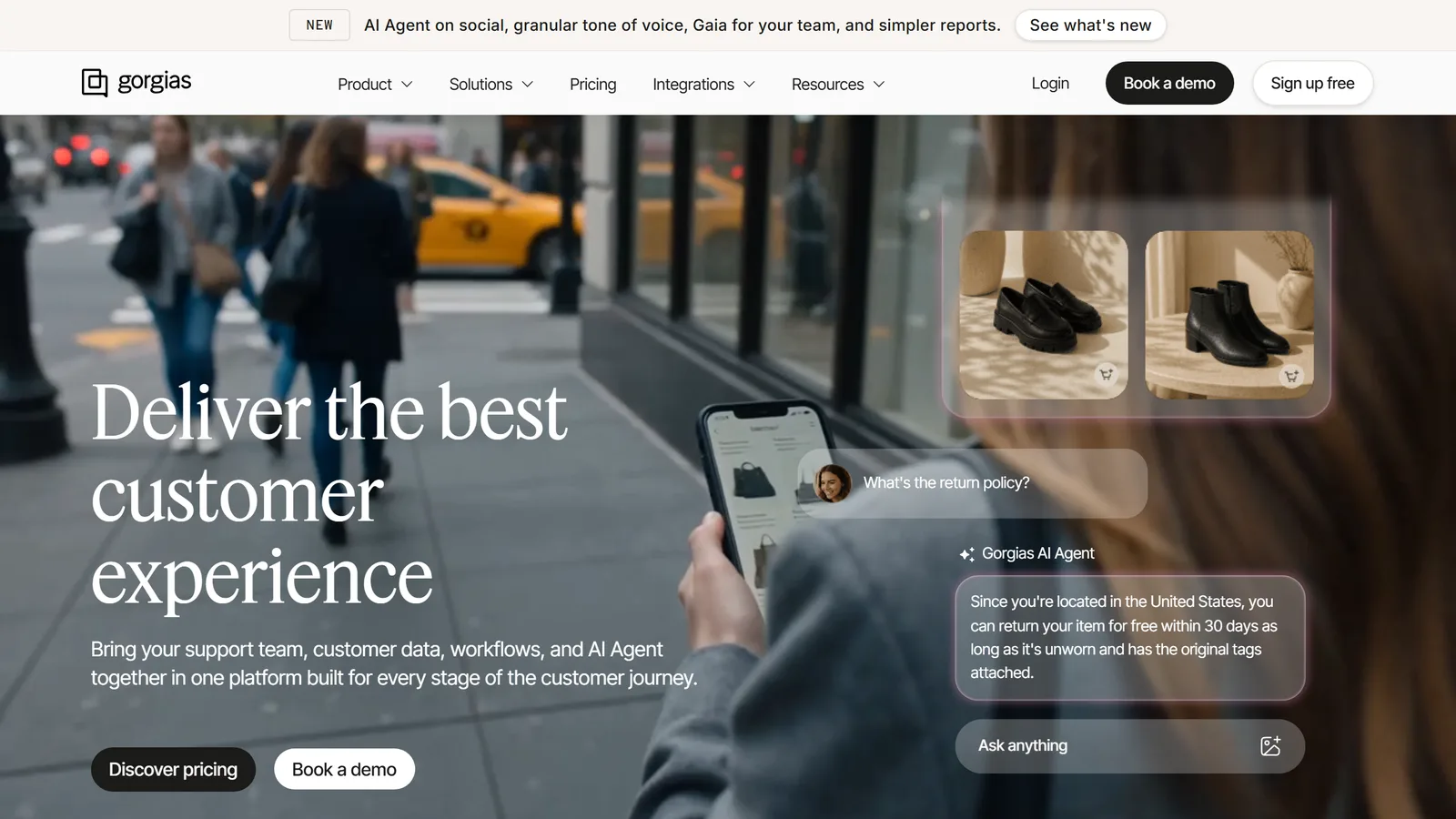
Gorgias is a helpdesk built for Shopify brands. Email, chat, social, text and voice land in one inbox, and its AI Agent answers customers on its own.
The AI Agent goes beyond answering. On Shopify, it can cancel an unfulfilled order, refund an item, change a shipping address, reship or replace an item, and pull tracking. Its Shopping Assistant handles the sales side in the same chat, recommending products and offering discount codes.
Gorgias prices by ticket volume, not by seat, which suits teams with seasonal staff. Starter is $10 a month for 50 tickets, and Basic is $50 a month billed annually ($60 monthly). The AI Agent adds $0.90 to $1.00 per resolved interaction, and each one also counts as a ticket.
Where it fits: Shopify and Shopify Plus brands that want support and sales in one place.
Not the right pick if: you’re not on Shopify. Gorgias’s own help docs say its AI Agent isn’t supported on BigCommerce, Magento or WooCommerce stores. And if you need AI order actions, skip Starter, which leaves them out along with brand voice controls.
Best for: Shopify brands that want one helpdesk where AI resolves questions, takes order actions and sells.
2. Intercom Fin
Intercom is a customer service platform with a built-in AI agent, Fin. Fin answers customers from your help content and takes actions in your other systems.
Fin’s ecommerce side is strong. Ready-made connectors for Shopify, WooCommerce and BigCommerce let it look up orders, cancel or update them, and issue refunds. It works across web and mobile chat, email, WhatsApp, Messenger, Instagram, SMS and Slack, with a phone version available through sales. Fin can also run on top of another helpdesk, such as Zendesk or Freshdesk.
Pricing has two parts: helpdesk seats (from $29 per seat a month, with a new-customer offer at the time of writing) and $0.99 per outcome for Fin.
Where it fits: brands that want one AI agent handling order requests on most channels.
Not the right pick if: you need a predictable monthly bill. On Intercom’s own helpdesk, seats and outcomes are two separate meters, and an “outcome” also counts when a customer simply stops asking for more help. It’s also not the pick if you want shopping features beyond web chat: product picks, cart and checkout work there only, and order actions need connector setup first.
Best for: mid-size and larger brands that want order-capable AI across most channels and can budget for seats plus outcomes.
3. Zendesk
Zendesk is one of the largest customer service platforms, covering ticketing, messaging, voice and social, with AI agents that resolve requests across messaging, email and voice.
Its strength is breadth. One platform covers email, live chat, phone, social, WhatsApp and text, and AI agents answer in more than 80 languages. You pay for AI only when it resolves a request: each plan includes a few automated resolutions per agent, and extras cost $1.50 to $2.00.
Plans start at $19 per agent a month for Support Team. Suite Team, at $55 per agent, adds messaging and telephony.
Where it fits: brands with a large team, many channels and the people to configure integrations.
Not the right pick if: you want AI that handles Shopify orders out of the box. Zendesk’s help docs say linking its AI agents to orders takes a custom API call (the steps differ with its Advanced add-on), and prebuilt refunds and cancellations come with its Copilot add-on, with a person approving. Smaller Shopify stores may also find costs stack up across seats, add-ons and resolutions, and its Shopify app averages 3.2 stars from 96 reviews.
Best for: mid-size and enterprise brands on many channels with staff to set up AI actions.
4. Tidio (Lyro)
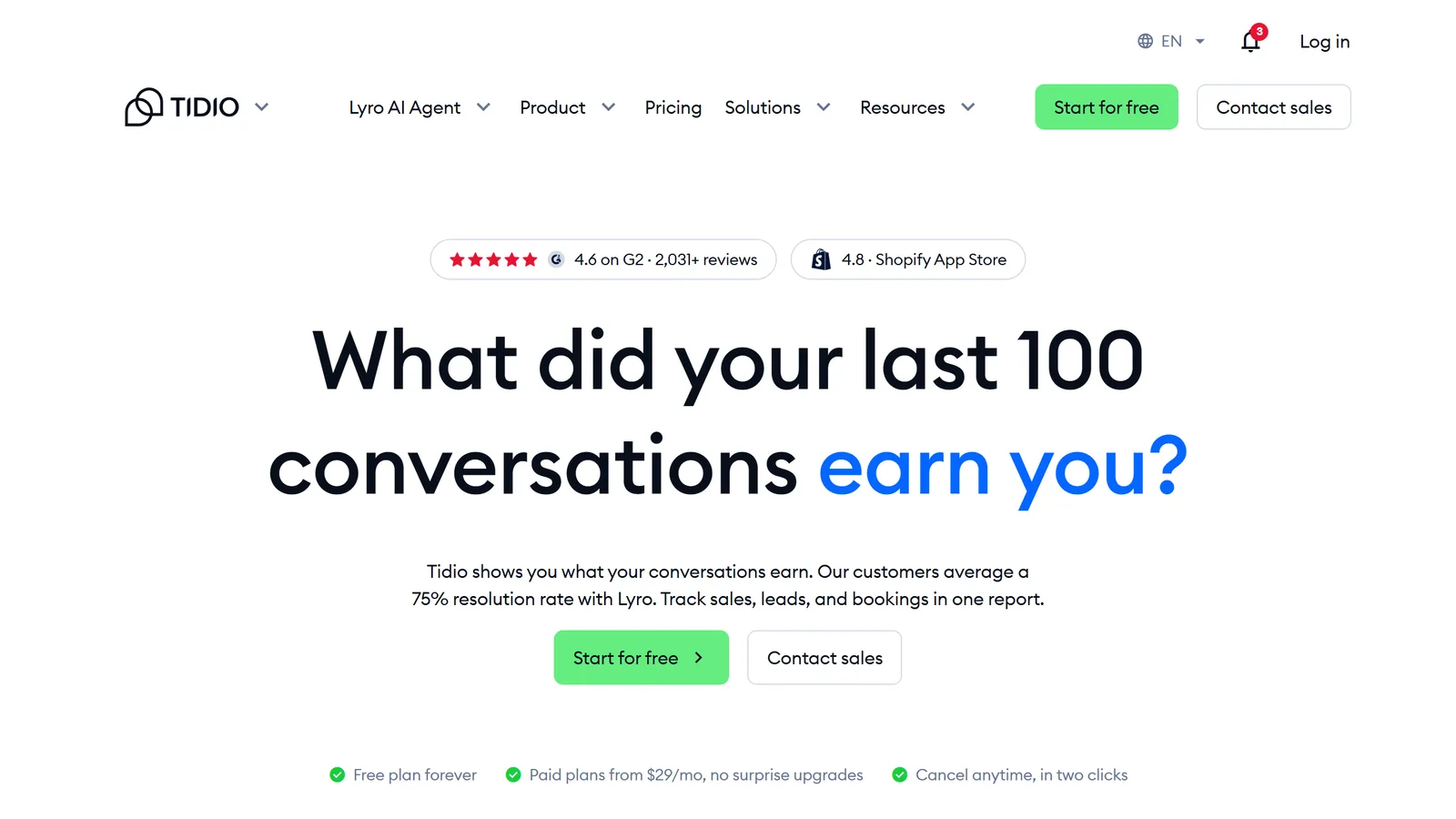
Tidio is live chat and a helpdesk for small and mid-size stores. Its AI agent, Lyro, answers shoppers from your own content.
Tidio is the easiest place to start. There’s a free plan, a 7-day trial with no card, and Lyro from $33 a month billed annually ($39 monthly). Lyro checks Shopify order status on every plan, recommends products with add-to-cart cards, and answers on live chat, Messenger, Instagram, WhatsApp and email. Its Shopify app is rated 4.8 from more than 1,300 reviews.
Tidio prices by conversations, and Lyro and your team share one monthly quota.
Where it fits: small and growing Shopify stores that want a low-cost AI agent for common questions.
Not the right pick if: you’re a smaller team that expects more than 1,000 conversations a month, or you want the AI itself to refund or cancel orders. Lyro and your team share one quota (50 conversations on Starter, up to 1,000 on Growth; higher plans are custom), and Lyro’s only ready-made Shopify template is order status, so refunds and cancellations mean building a custom action. Your team can cancel, refund and edit orders from the inbox, but only on Growth and up. One review mentions billing details that weren’t clear up front.
Best for: small Shopify stores that want an affordable, self-serve AI agent.
5. Freshdesk
Freshdesk is a help desk from Freshworks with a built-in AI agent, Freddy, plus an assistant for human agents.
Freshdesk is one of the cheapest ways into a full help desk with AI. Plans start at $19 per agent a month, and each account gets its first 500 AI agent sessions free. It comes with ready-made AI workflows for Shopify order status, past orders and refund status, plus order lookups for Magento and BigCommerce.
The base product is email-first. Freshdesk Omni, from $29 per agent a month, adds chat, WhatsApp, Messenger and Instagram, with phone as a paid add-on.
Where it fits: cost-conscious teams, including those on Magento or BigCommerce.
Not the right pick if: you want every AI feature on the starting plan. The agent assistant isn’t on Growth, AI insights are Enterprise only, and AI sessions past the first 500 cost $49 per 100. Reviewers on G2 and Capterra flag limited reporting, and some mention the cost of AI add-ons.
Best for: small and mid-size teams that want an affordable help desk whose AI can look up orders across several platforms.
6. Yuma AI
Yuma AI is an AI agent that works inside the helpdesk you already use and closes ecommerce tickets on its own.
You don’t switch helpdesks. Yuma lists ten it works inside, including Gorgias, Zendesk, Kustomer and Gladly. In Shopify it cancels, refunds (full, partial or by percentage), reships, edits line items and changes addresses before fulfillment, and it connects to subscription, returns and shipping apps. Refund caps and handoffs to a person when a policy is unclear are built in.
You pay only for full resolutions, never per seat. Starter is $14,400 a year for 12,000 resolutions, and Yuma notes these are illustrative annual prices with monthly plans also available.
Where it fits: brands with steady ticket volume who like their helpdesk and want stronger AI inside it.
Not the right pick if: you’re a small store or want to stay flexible. It starts at $14,400 a year on a 12-month commitment, and on annual plans the AI pauses if you use up your bundle before renewal. BigCommerce, Magento and marketplace sellers should also check fit, since Yuma’s integrations page lists no native connector for those (custom API connections are possible).
Best for: mid-size and larger Shopify brands that want to keep their current helpdesk and pay only for tickets the AI fully closes.
7. Richpanel

Richpanel is an AI-first helpdesk for ecommerce. You move your team onto it, and its AI agents answer and resolve tickets.
Richpanel documents clearly what its AI can do: refunds, cancellations, address changes, order edits and subscription changes across Shopify, Recharge, Loop Subscriptions, Skio, ShipHero and AfterShip. Each action can run on its own or wait for a person’s approval. It covers email, chat, text, WhatsApp and social, including comments and DMs.
Pricing is $99 per seat a month plus about $0.20 per AI conversation, with a floor of $299 a month on an annual plan. New customers get a written guarantee: if AI doesn’t resolve half of eligible conversations in the first 30 days, Richpanel refunds that month’s subscription fees, with conditions.
Where it fits: Shopify brands, especially subscription brands, ready for an AI-first helpdesk.
Not the right pick if: you want to keep your current helpdesk, since Richpanel replaces it rather than running inside it. Also check its own list of what the AI doesn’t do yet, such as act on Loop Returns or open a new return (customers start those in the portal). No free trial is listed; it offers a demo and a money-back guarantee instead.
Best for: Shopify-first and subscription brands ready to leave their current helpdesk for one AI-first platform.
8. Gladly
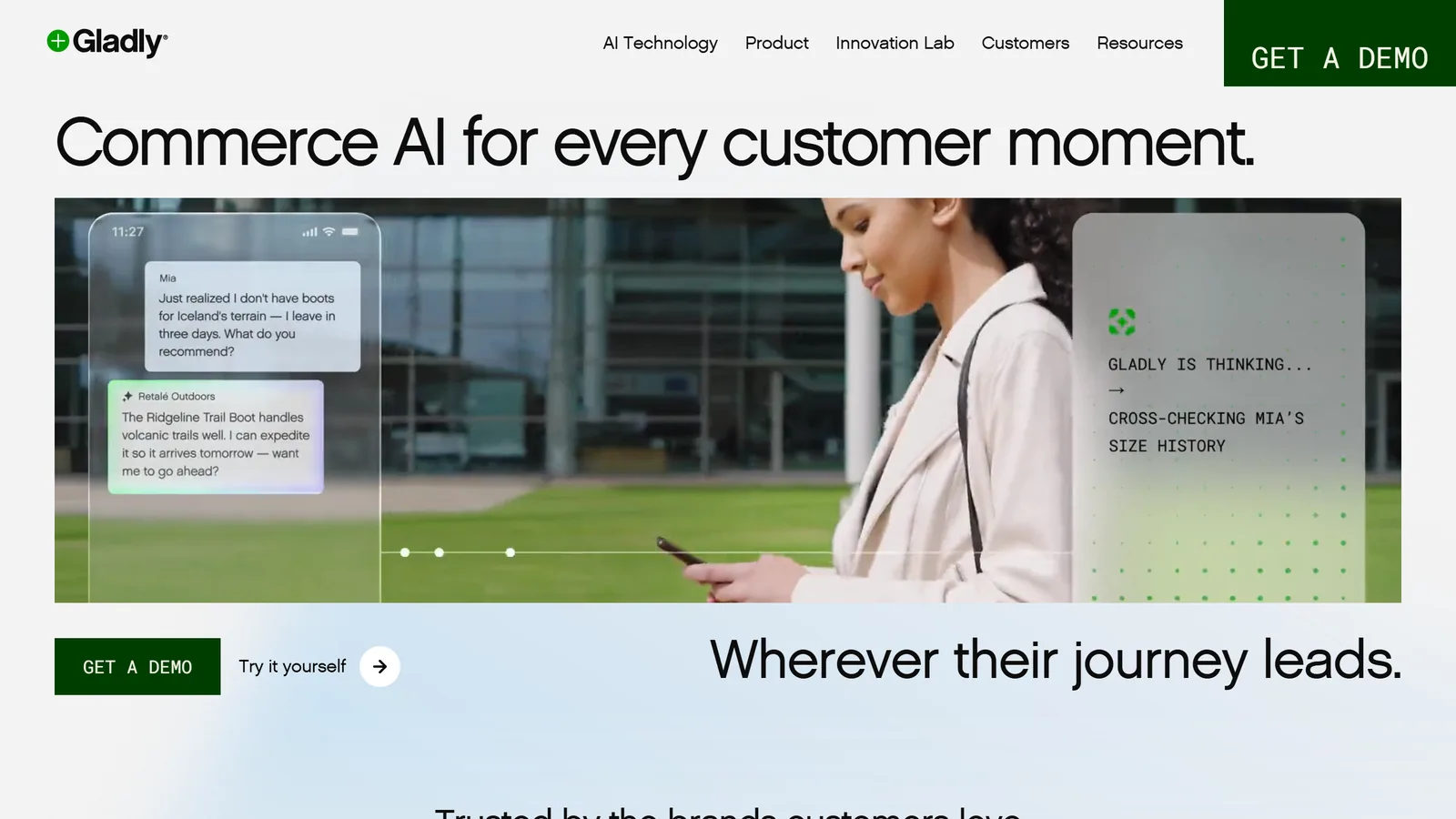
Gladly is a customer service platform for retail brands where AI and human agents share one ongoing history for each customer, across every channel.
That shared history is the point: a shopper who texts, then calls, then chats doesn’t have to start over. Gladly covers chat, email, text, phone (with an AI voice agent), Instagram, Messenger and WhatsApp. On Shopify, its AI can cancel orders, issue full or partial refunds and store credit, change addresses and create replacement orders, with admins choosing what it’s allowed to do. The same AI can also recommend products and check out inside the chat.
Pricing is custom and goes through sales.
Where it fits: retail brands with a real support team that want AI and people working from the same customer record.
Not the right pick if: you’re a small team or want to see prices before talking to sales. There’s no public pricing or free trial listed, and a customer review mentions a minimum number of seats. One reviewer also mentions reporting that feels limited.
Best for: mid-size and enterprise retail brands that want one customer history across AI, agents and every channel.
9. Ada
Ada is an enterprise AI agent that answers and resolves customer questions across chat, messaging, email and voice, with 60 languages on messaging.
Ada is built for very high volume. Teams build step-by-step playbooks for jobs like refunds and returns, then test them before launch. Ada names ecommerce results on its own site, including IPSY, iHerb and Simba Sleep. In November 2026, Ada and Dialpad announced they’re joining forces, and both say current customers’ contracts and support continue as before.
Pricing is custom. Ada’s G2 listing shows plans from $60,000 a year, billed per conversation.
Where it fits: large brands with hundreds of thousands of conversations a year and a team to run the AI.
Not the right pick if: you want to try before talking to sales, or you want a store connection that’s listed and ready to switch on. Ada lists no prices or free trial and is built for large support teams. Its integrations page lists no Shopify, BigCommerce or Magento connector, and its docs describe connecting other systems through API tools you configure. Reviewers mention reporting across several bots as an area to improve.
Best for: high-volume enterprise brands that want one AI agent across every channel and can invest in setup.
10. Ringly
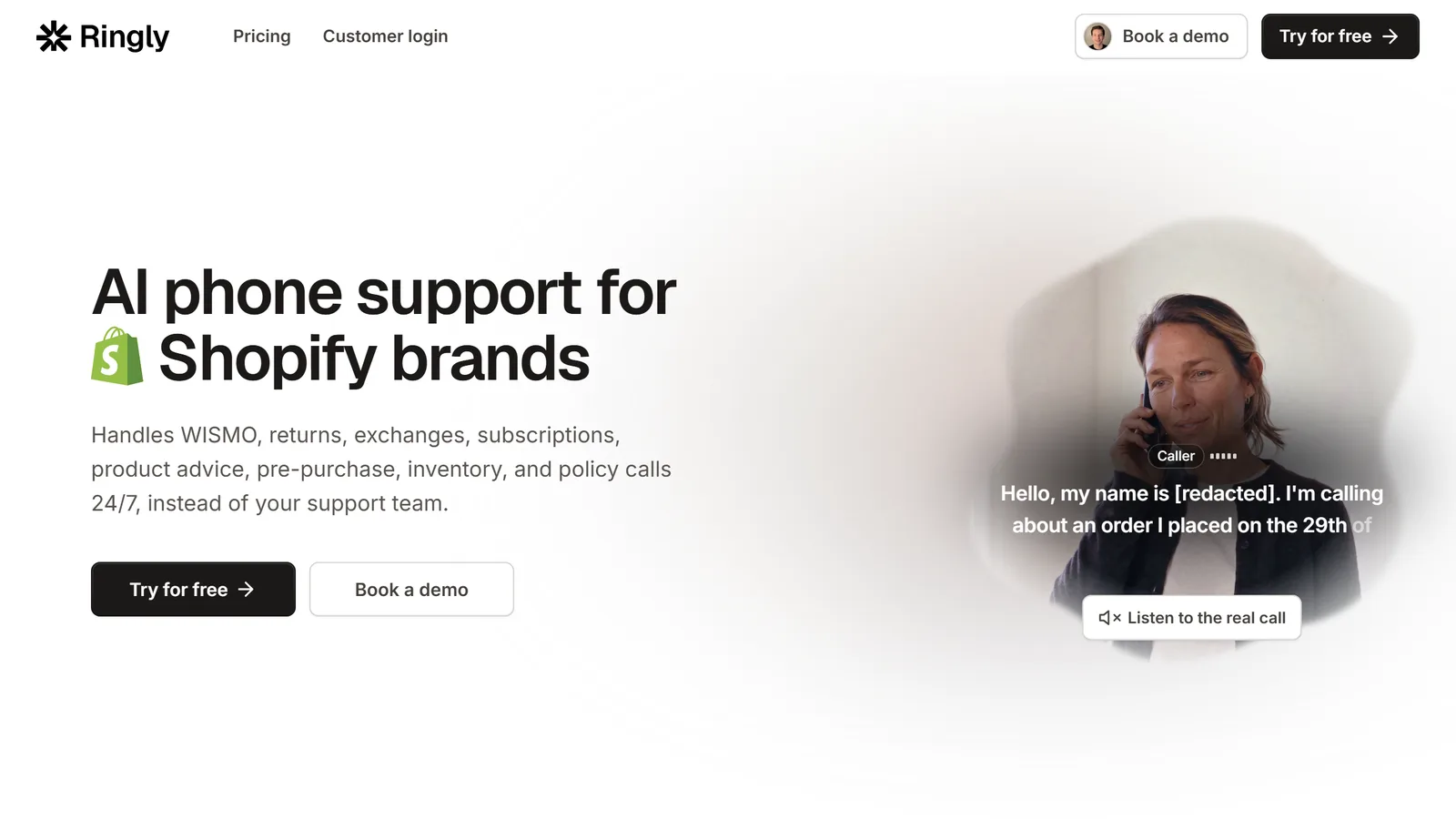
Ringly gives Shopify stores an AI phone agent, Seth, that answers customer calls 24/7.
Phone is where many support tools are weakest, and it’s all Ringly does. Seth recognizes callers by phone number, looks up their order, reads status and tracking, cancels orders that can still be cancelled, starts returns and passes the rest to your team. It speaks 40 languages. For brands that get a steady stream of calls, AI phone support for Shopify brands like this is a simple way to cover the phone without hiring.
Pricing is public and simple: $99 a month covers your first 50 phone conversations, then $1.99 each. Spam, hang-ups and wrong numbers aren’t charged, and there’s a 30-day money-back guarantee.
Where it fits: Shopify stores with real call volume.
Not the right pick if: you need help with chat or email too. It’s phone only and built for Shopify. Ringly’s own page says Seth doesn’t take payments on calls or cancel subscriptions natively, and it has only a handful of public reviews so far.
Best for: Shopify stores that want every call answered 24/7, paying per call.
Picking the right one
Start with your platform. If you’re on Shopify, most tools here connect to it, and Gorgias, Tidio, Richpanel and Ringly are built around it. On BigCommerce, look at Freshdesk, Intercom Fin and Gladly. On Magento, Freshdesk and Gladly list support.
Then decide whether you want a new helpdesk. Gorgias, Zendesk, Freshdesk, Tidio, Richpanel and Gladly replace what you have. Yuma and Fin can work with the one you’ve got.
Finally, match the pricing to your volume. Per-seat pricing suits small, steady teams. Per-ticket and per-resolution pricing suits teams that grow and shrink with the season. For a small store, Tidio’s free plan is the lowest-risk start. For phone, add Ringly alongside whichever tool handles your chat and email.
How to test one before you buy
Most of these tools offer a trial or a guarantee, so test with your own tickets, not a demo script.
- Pull your last 100 real customer questions, in the shoppers’ own words.
- Run them through the AI and score the answers: right, wrong, or handed off.
- Try the order actions in a test store, including a refund, a cancellation and an address change.
- Work out the monthly cost at your real volume, including AI fees, add-ons and overages.
- Check what happens when the AI doesn’t know: does it hand off cleanly, with the conversation intact?
Support tools answer “where’s my order?” Who answers “which one is right for me?”
Order questions are what these tools are built for. Status, tracking, returns and refunds are facts in your store, and with the right setup the AI can look them up.
Product questions are different. “Which of these strollers fits in a small car trunk?” or “Will this jacket be warm enough for a Chicago winter?” don’t have an answer in your order data. They need judgment, the kind your merchandising team uses every day. When a support AI doesn’t have that judgment, it pieces together an answer from product descriptions, and it may not be the one your team would give.
That’s the part Cartful helps with. Your team writes down who each product is right for, who it isn’t, and why, and Cartful puts those answers into your product data and onto your site. So whether a shopper asks your chat agent, calls your phone line or asks an AI assistant, the answer comes from the same place.
If you’d like to see what that looks like on your own catalog, we’re happy to walk you through it.
Frequently asked questions
What is the best AI customer service tool for ecommerce?
It depends on your platform and size. For most Shopify brands, Gorgias is the most complete all-in-one choice. Intercom Fin is strongest for order actions across many channels and carts, Tidio is the best low-cost start for small stores, and Zendesk and Gladly suit large multichannel teams.
How much do AI customer service tools cost?
Pricing models vary. Some charge per seat (Zendesk from $19 per agent a month, Freshdesk from $19), some per ticket (Gorgias from $10 a month), and some per AI resolution or conversation (Intercom Fin at $0.99 per outcome, Richpanel at about $0.20 per AI conversation). Enterprise tools like Gladly and Ada are custom. Prices here were checked on November 20, 2026.
What’s the difference between an AI chatbot and an AI agent?
A chatbot follows scripts or answers from a knowledge base. An AI agent can also take actions in your systems, like cancelling an order or issuing a refund, within limits you set.
Can AI customer service tools handle refunds and order changes?
Many can. Gorgias, Intercom Fin, Yuma, Richpanel and Gladly can cancel, refund or edit Shopify orders. Others answer order status out of the box but need setup, a higher plan or a human in the loop for actions that change an order.
Do these tools work with my existing helpdesk?
Some do and some replace it. Yuma can run inside helpdesks such as Gorgias or Zendesk, and Intercom Fin can run on top of Zendesk, Salesforce, HubSpot or Freshdesk. Gorgias, Zendesk, Freshdesk, Richpanel and Gladly are helpdesks themselves.
How should I test an AI customer service tool before buying?
Run your own recent customer questions through it, check its order actions in a test store, and work out the monthly cost at your real volume. A trial or money-back guarantee makes this low risk.
What’s the best option for a small store?
Tidio has a free plan and AI from $33 a month billed annually ($39 monthly). Gorgias starts at $10 a month for 50 tickets. If phone calls are your main problem, Ringly starts at $99 a month for 50 calls.